Sensors Reveal What Damp Hides
An Article By: DampSmart
What our sensor technology revealed about a recurring damp problem — and why the data changed everything.
There is a particular kind of frustration that comes with a problem you cannot see the end of. You do everything you are told. You spend the money. You follow the advice. And then it comes back.
That is exactly where our client found themselves in 2025. A Victorian house near the coast. A damp wall that had resisted every fix thrown at it for the better part of five years.
They had tried everything. And they were starting to wonder if the problem was them.
Five Years of Doing the Right Things
Before they came to us, this client had already gone through the standard checklist that most homeowners in older properties will recognise. They had the patio lifted and a French drain dug to redirect surface water away from the building. They ventilated the home — not casually, but with real commitment, opening windows, running extraction, watching for signs of condensation. They kept the heating consistent, knowing that cold surfaces are a risk factor for moisture accumulation. None of it resolved the problem.
In 2020, they made the decision that felt definitive. They brought in a specialist damp and remediation contractor, paid over £4,000 for the wall to be fully stripped back, tanked with a cavity drain membrane system, replastered and made good. The work came with a 15-year guarantee. It felt, finally, like the matter was closed.
Five years later, the moisture was returning. And now they had a harder question to sit with: if the remediation had failed, what did that mean for the guarantee, for the contractor, and for the next £4,000 they might have to spend?
The most difficult part was the uncertainty. Without data, every explanation was equally plausible — and equally worrying.
Deploying Sensors to Separate Behaviour from Building Performance
When a client comes to us with a recurring damp problem, the first thing we do is listen to their account. The second is to stop guessing and start measuring.
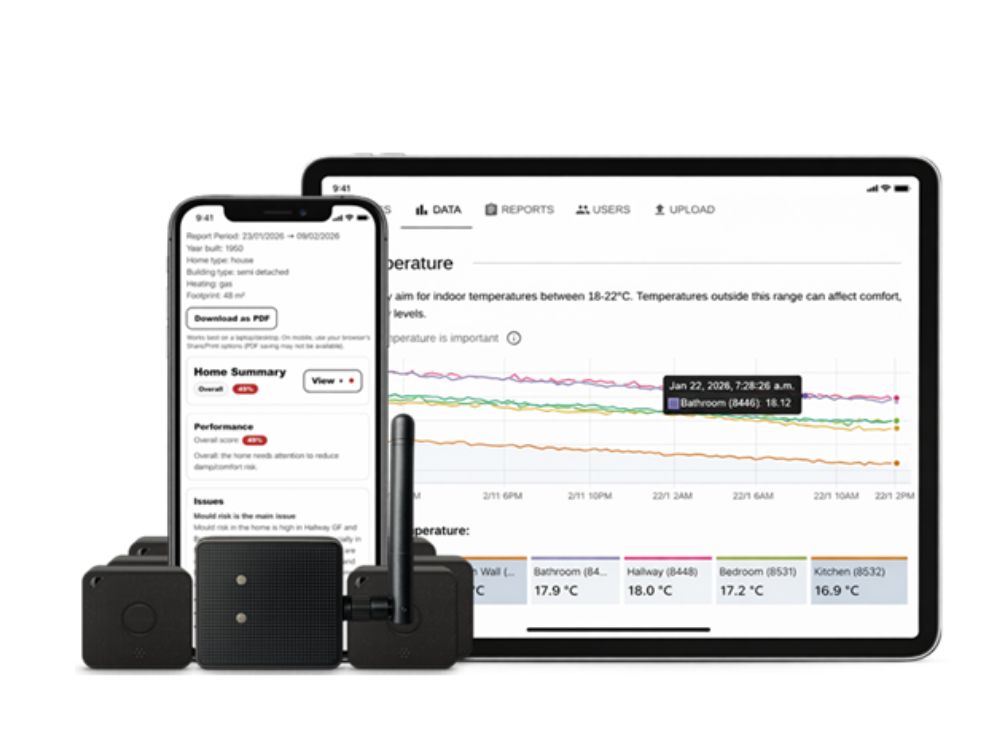
We have designed our sensors so they are ultra small and are networked without the need for WiFi. Each sensor is battery powered and talks to a central hub that connects to our analytics platform via mobile networks.
Each room and several surfaces had a sensor so we could apply the building science and get a complete view of how the home performs: moisture load, temperature, humidity, ventilation, insulation, moisture extraction, habits — and critically — how the wall itself was behaving in response to changing conditions inside and outside the building.
The data gave us clear answers on the factors most commonly blamed for damp in older homes. The property’s indoor-to-outdoor moisture balance was well managed — windows were being opened regularly and for extended periods, creating genuine drying potential rather than token ventilation. When moisture levels spiked, as they do in any occupied home through cooking, bathing and breathing, the mechanical extraction was removing the excess within fifteen minutes. Surface temperatures across the building envelope were consistently above the dew point, meaning condensation was not forming. Insulation performance was adequate.
In short, the occupant behaviour was exemplary. There were no environmental conditions that would produce mould growth or sustained moisture accumulation from how the home was being used.
The sensors did not just identify the problem. They exonerated the people living there.
What the Wall Was Telling Us
The wall told a different story.
Moisture readings on the wall surface showed a pattern inconsistent with environmental damp or condensation. On certain days, moisture levels in the wall increased regardless of what was happening inside the home — even with good ventilation, stable temperature and low indoor humidity. The wall was holding moisture for extended periods and releasing it slowly, in a pattern characteristic of water ingress through a compromised building element rather than vapour-driven moisture from the interior.
This is the distinction that matters. Condensation and lifestyle-related damp respond to changes in behaviour and environment. Penetrating damp and failed remediation do not. The data made this separation visible, clearly and without ambiguity.
A Note for Contractors and Remediation Specialists
We want to be direct about something here, because we think it matters for the sector.
Sensor technology is not a tool for catching contractors out. In the majority of cases where we monitor a property following remediation work, the data confirms that the work has performed as expected and that any recurring moisture is driven by behaviour, ventilation habits, or wider building fabric issues that sit outside the scope of the original contract.
In those cases, the data is the contractor’s best defence. It provides objective, time-stamped evidence that the remediation held, that the damp proof course or membrane system is performing correctly, and that the root cause of a returning problem lies elsewhere. For any contractor operating with integrity, that is an enormously valuable thing to be able to demonstrate to a client.
In this particular case, the data pointed the other way. But even here, the value is clear: rather than years more of inconclusive investigation, conflicting opinions and escalating costs, the client had a precise, evidence-based picture of the problem within weeks of monitoring beginning. The next contractor who attended could go straight to the relevant area with confidence. The guesswork was eliminated.
Good workmanship has nothing to fear from good data. And where workmanship has fallen short, data accelerates the path to resolution for everyone involved.
The Resolution — and What It Cost
Armed with the monitoring data, the client instructed a second specialist contractor — one with the appropriate insurance, accreditation and experience in remediation of failed damp proof courses. When the plaster was stripped back, the diagnosis was confirmed: the original damp proof course had failed as a result of poor workmanship.
The remediation cost a further £3,000. Added to the original £4,000, the total spend on this wall across five years reached £7,000 — a significant sum, compounded by years of anxiety, repeated investigations and the creeping sense that the problem might never be fully resolved.
The wall is now dry. The new contractor has recommended periodic moisture checks as part of ongoing maintenance, and our sensors remain in the property, building a long-term performance profile that will give the client early warning of any change in the wall’s behaviour before it becomes a visible or structural problem.
“The sensor technology and analytics gave us a clear path to discovering the root cause and making the right choice with confidence.” — the client, 2025
What This Case Demonstrates
Across thousands of monitored homes, we see the same pattern: a recurring problem, a reasonable explanation that turns out to be incomplete, and a homeowner or landlord spending money in the wrong direction because they lack the evidence to identify the right one.
The answer is not to do more of the same things. It is to measure what is actually happening, separate the factors that can be influenced from the factors that require structural intervention, and then act with confidence on what the data shows.
That is what sensor-based environmental monitoring makes possible. Not overnight, but methodically. And in this case — by eliminating lifestyle, ventilation, heating and environmental moisture as causes, and then isolating the behaviour of the wall itself — what had been a five-year nightmare became, in the end, a solvable problem.
About DampSmart
DampSmart provides continuous environmental monitoring for residential and commercial properties, giving homeowners, landlords, letting agents and contractors the data they need to understand, evidence and resolve damp, mould, ventilation and insulation issues.
Find out more at www.dampsmart.co
#DampProofing #RisingDamp #PenetratingDamp #WallMoisture #DampAndMould #BuildingEnvelope #PropertyMaintenance #VictorianHomes #HomeImprovement #ConstructionTech #SensorTechnology #RemediationContractors #DampProofCourse #PropTech #BuildingScience