
From Projects to Clients: The Architect’s Path
You focus on great designs. Finished projects that you promote to get more clients and more projects.
But what if attracting dream clients wasn’t just about what you’ve built, but also about guiding clients at every stage: before they’re ready, while they’re exploring, and when they decide?
Let me explain.
As an architect, you want potential clients to see how your services solve their problems so they hire you. But just asking “Hire me” usually doesn’t work right away.
Asking a client to hire you is about building a relationship first.
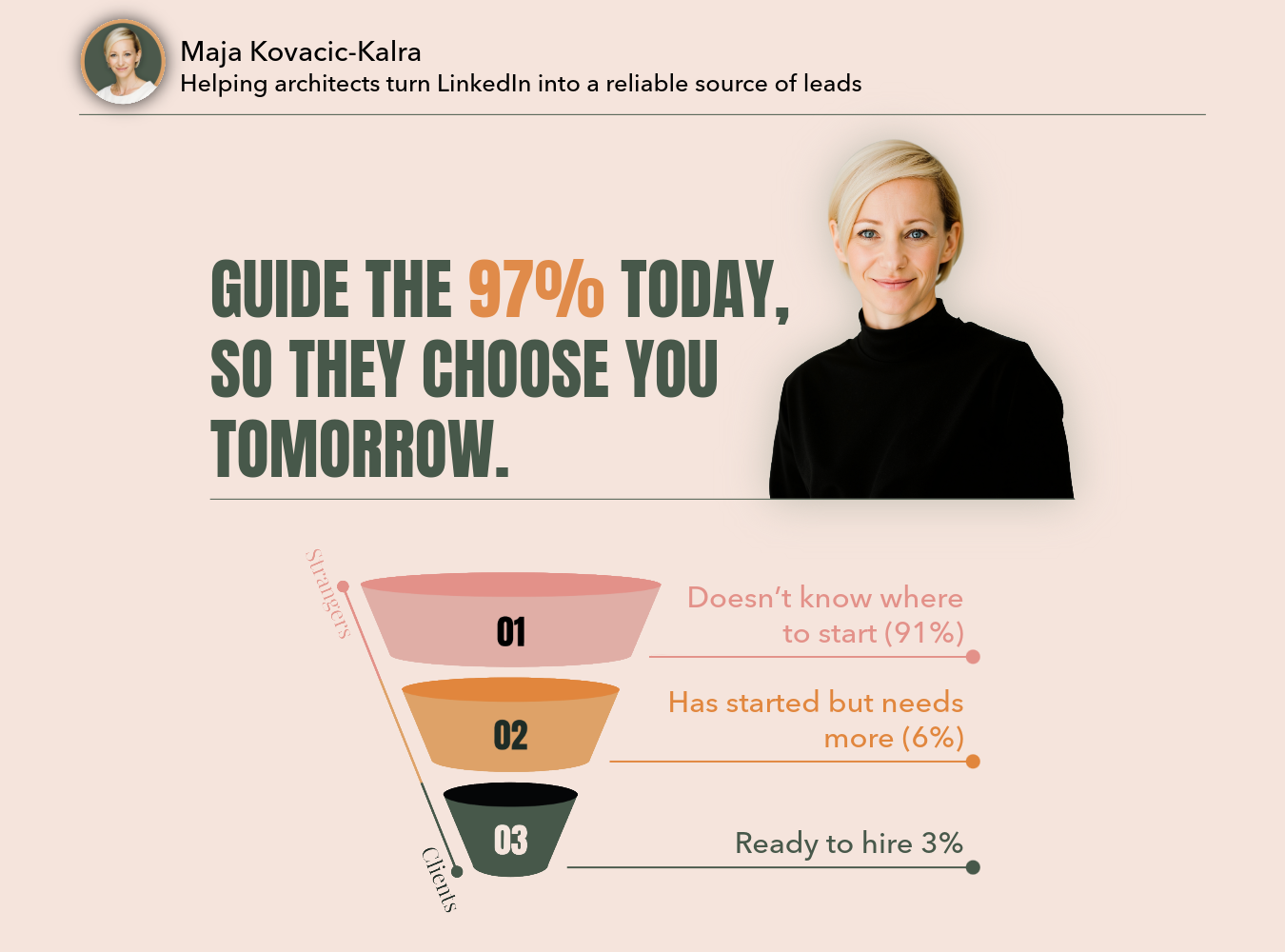
At any one time, only a small percentage of people are ready to hire an architect. Around 3%. Another 6% are considering their options. That leaves 91% who aren’t ready yet.
If you only focus on the 3% who are ready today, you’re ignoring the majority of your future clients. But when you show up for the 97%, building relationships, educating them, and showing you understand their problems, you’ll already be the obvious choice when they are ready.
Here are the three stages many potential clients move through before they commit, and what you can do at each stage.
Stage #1. Doesn’t know where to start
At this stage, people feel stuck. They’re frustrated with their home or space but don’t know why. They’re not searching for an architect yet. They just want the discomfort to stop.
They need to feel understood. They need to believe change is possible, even if they can’t imagine it yet.
What you can do:
- Social media post: Share frustrations your clients feel: “Your home feels dark even with big windows? It’s not always the furniture, it’s often the layout.”
- Blog article: Write about relatable issues like “5 reasons your home feels stressful (and how design fixes it).” Blogs like this get found on Google and position you as someone who understands.
- Website: Keep your homepage simple. In five seconds, visitors should know who you help, how their life will improve, and what step to take next.
- Lead magnet: Offer a free guide such as “7 ways to make your home feel lighter and more spacious without moving.” This builds trust and lets you stay connected.
Stage #2. Has started but needs more
Now they know what’s wrong. They’ve tried fixes, searched online, spoken to friends, maybe even asked a builder. But they’re overwhelmed by options. They want clarity, not more ideas.
What you can do:
- Social media post: Share client stories: “A family thought they needed an extension. After our design review, we reconfigured their space instead. They saved money and gained light.”
- Blog article: Write educational pieces like “10 things to know before planning a home extension” or “Renovate or rebuild? How to decide.”
- Website: Show your process in 3-4 steps in plain language so it feels approachable.
- Lead magnet: Create a checklist such as “Your Home Extension Planning Checklist: 13 things to know before you start.” Follow it with a short email series that educates and reassures.
Stage #3. Needs more clarity before deciding
Here, people are ready to act. They’ve narrowed their options and are deciding who to trust. They’re not wondering if they’ll do the project, but who they’ll choose.
What you can do:
- Social media post: Share before-and-after transformations, but focus on how life improved for the client, not just how the design looks.
- Blog article: Publish case studies that tell the full story, the client’s problem, your process, and the outcome. Real examples reduce doubt.
- Website: Make booking a consultation easy. A clear “Book a call” or “Start your project” button should be visible everywhere.
- Lead magnet: Create a short “First Consultation Guide” explaining what happens in the first meeting and how to prepare. This removes uncertainty and makes the step feel natural.
Always include a call to action. Tell people what to do next to get them closer to working with you.
If you only focus on the small group who are ready now, you’ll keep chasing work. But when you guide people step by step, you build relationships with the 97% who aren’t ready yet, and those are the people who will become your future clients.
The Takeaway
Think of it like this:
– First you spark curiosity.
– Then you build trust.
– Then you ask for commitment.
That’s the path most clients take before they choose you.
Building trust takes time. But just like a strong foundation, it’s what holds everything else together.
Want Your Portfolio To Speak To Clients, Not Just Show Projects?
Your projects already look great, but do the descriptions really connect with the clients you want to work with?
I’m opening a few spots for portfolio makeovers, where I’ll rewrite yours into project stories so they speak directly to your ideal clients.
Bonus: Architecture Vogue members get £200 off.