Why Client Experience Is Becoming Architecture’s Biggest Differentiator
An Article By: Lindsay Mattinson of Pulse
It is Sunday afternoon. You are writing a fee proposal. Again. Somewhere in a different tab, three client emails are waiting. An approval from last week is still unconfirmed. And the update you promised on Friday exists, so far, only in your head.
This is not a time management problem. It is a structural one. The information your practice needs to run well is scattered across inboxes, shared drives, message threads and memory. Nobody designed it that way. It accumulated, project by project, year by year, until the administrative weight became simply part of what the job feels like.
Up to 40 percent of director time goes on managing information rather than designing. Status updates, chasing approvals, reconstructing decisions from scattered archives. Hours that do not appear on any invoice and do not move any project forward. A silent tax, paid every week, by almost every practice.
The client feels it too. Not the admin, but the silence that surrounds it. The days without an update. The sense that progress is happening somewhere they cannot see. Clients now receive real-time visibility from their bank, their contractor, their GP surgery. Waiting weeks for a project update no longer feels like standard practice. It feels like a gap.
You have tried to fix it. Asana or Monday for tasks. ChatGPT for drafting. A shared drive for documents. Each solves one piece. None of them know your practice. None understand RIBA stages, scope exclusions, or how your fees are structured. Every time you open them, they start from zero.
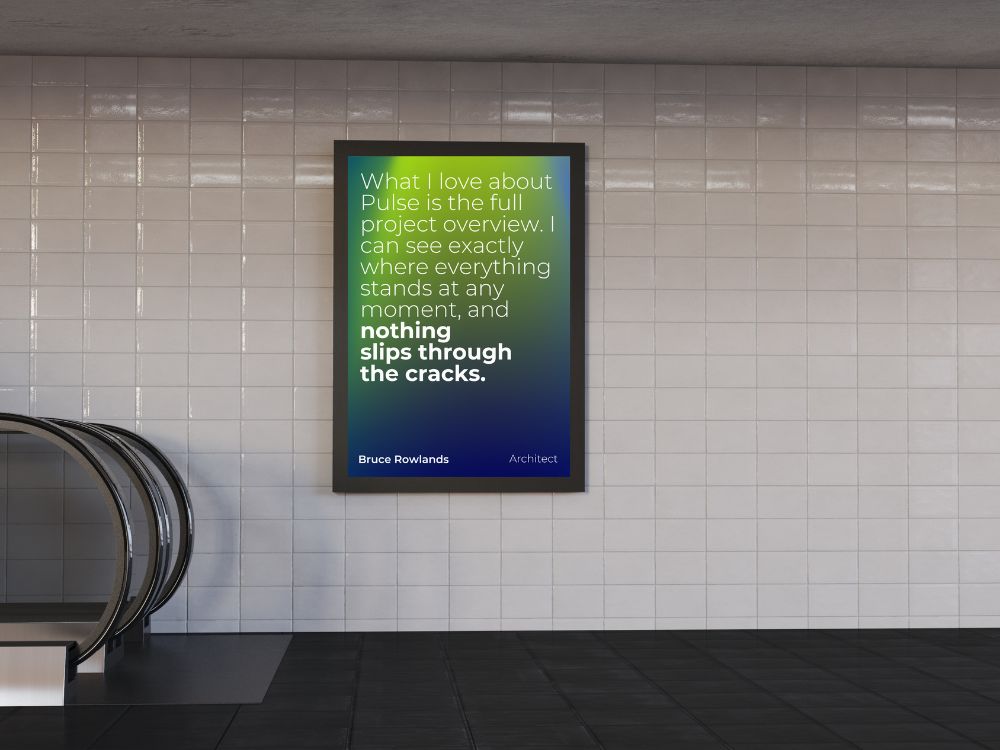
Pulse is built differently. Not as a project management tool with AI features added. As a practice intelligence layer: software that learns how your practice actually works and does the repetitive administrative work in your voice. You upload your last twenty to fifty proposals, reports and key documents. Pulse reads them, organises them and builds a picture of how your practice writes, prices and delivers. By the fourth fee proposal, it sounds like you wrote it. You edit. You do not draft from scratch.
Co-founded by Lindsay Mattinson, an architect with more than thirty years in practice, and Lewis Wood, Pulse was built from inside the profession. Every workflow was tested on real proposals, for real clients, before a single customer saw it. The starting question was simple: what would software look like if it actually understood architecture? Not adapted to it. Built for it.
For the client, this changes what the experience of a project feels like. Updates arrive consistently, in the practice’s voice, without anyone having to draft them manually. Decisions are logged as they happen. Approvals are traceable. The client has a clear, real-time view of their own project without needing to ask. Trust is not built in the final reveal. It is built across every week of the work.
For directors, the change is in how oversight feels. Rather than reacting to problems once they have developed, the practice has a live view across every project. Risk is flagged early. Scope creep is caught mid-project. The Sunday anxiety about what might have been missed begins to recede.
Design quality has always mattered. It still does. But in a profession where many practices are producing work of genuine distinction, it is no longer sufficient on its own. The practices that define the next decade will be the ones that bring the same care and intelligence that goes into a drawing set into every aspect of how a project is communicated, documented and delivered.
Get your Sundays back.