
The EPC Doesn’t Tell You What It Costs to Stay Warm — And That’s a Problem
An Article By: Dampsmart
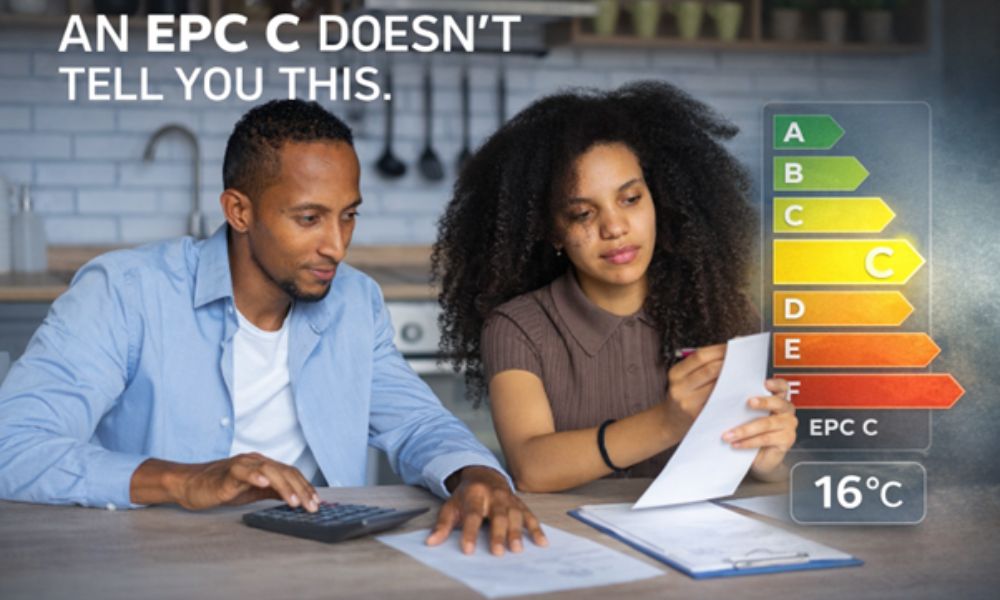
For years we have met families who moved into homes reassured by a single metric: EPC C.
They were told the property was efficient. They were told it would be affordable to run.
Then winter arrived — and they discovered something the EPC never told them:
How much it would actually cost to keep warm
At Dampsmart, we see this pattern repeatedly. Homes that look acceptable on paper turn out to be financially unmanageable in winter.
The Scale of the Issue
According to the Department for Energy Security and Net Zero, around 3 million households in England are classed as fuel poor under the Low Income Low Energy Efficiency (LILEE) metric.
The private rented sector is disproportionately represented within those statistics, and more than 4.6 million households now live in privately rented homes in England.
Demand for private rented housing has grown substantially over the past two decades, meaning more households are exposed to buildings they do not control and may not fully understand.
National Energy Action’s UK Fuel Poverty Monitor and Shelter’s housing research both highlight the increasing strain on renters as energy costs have risen.
Yet most tenants are never told what it will cost to maintain comfortable indoor temperatures before they sign a tenancy.
That gap matters
What EPCs Were Designed To Do
Energy Performance Certificates were designed to create a standardised comparison between properties.
The SAP methodology behind EPCs uses fixed assumptions about heating hours, occupancy patterns, internal gains and solar gains. That ensures comparability across the housing stock.
But it does not answer the question most tenants and landlords actually care about:
How much will it cost me to keep this home warm in winter?
- An EPC band does not represent continuous comfort heating.
- It does not reflect real behavioural patterns.
- It does not provide a clear winter budget figure.
And that distinction becomes painfully real when temperatures drop.
EPC C by 2030 — and the £10,000 Question
The Government has confirmed that private rented homes will be required to achieve a minimum EPC C rating by 1 October 2030. Landlords will be required to invest up to £10,000 per property on energy efficiency improvements to try to meet that standard, with exemptions available if that cost cap is reached.
The objective is clear: improve efficiency and reduce emissions.
In practice, “energy efficiency improvements” typically focus on measures that directly improve EPC scores — insulation upgrades, heating system replacements, glazing improvements or low-carbon technologies.
But there is a critical gap.
Ventilation — which is essential for moisture control, indoor air quality and comfort — does not drive EPC band improvement in the same way as insulation or heating efficiency.
This creates structural risk.
A landlord may spend £10,000 improving insulation or upgrading heating systems in order to reach EPC C, yet still face persistent damp and mould problems if ventilation and real heating affordability are not addressed.
Improving thermal efficiency without considering ventilation and occupant heating behaviour can increase humidity risk in under-heated homes.
The policy is focused on energy ratings.
But comfort, affordability and moisture stability depend on the whole building heat balance.
If ventilation and heating affordability are not considered alongside insulation, landlords risk exhausting their £10,000 investment without solving the problem tenants actually experience
When “Heating First” Doesn’t Fix the Problem
We have already seen this in practice.
In one recent project, a block of flats was rated EPC C. The recommendation was to upgrade the heating systems.
New systems were installed. Smart thermostats were added.
Residents still complained they could not heat their homes affordably.
The issue was not the boiler. It was the walls. Heat was escaping through poorly performing fabric at a rate that made comfort expensive to maintain.
At Dampsmart, we applied a heat-loss assessment grounded in established building physics principles consistent with BS EN ISO and BRE conventions. We calculated the Heat Loss Coefficient and modelled the energy required to maintain 20–21°C during winter conditions.
The result was clear: this was a fabric-first problem.
Once insulation improvements were implemented, comfort improved and heating became affordable.
A rating-led decision had delayed the right solution.
The Human Reality Behind the Statistics
This year we encountered homes where bedroom, hallway and lounge temperatures were as low as 14°C.
When we asked residents why they kept their homes so cold, the answer was simple:
“I can’t afford it.”
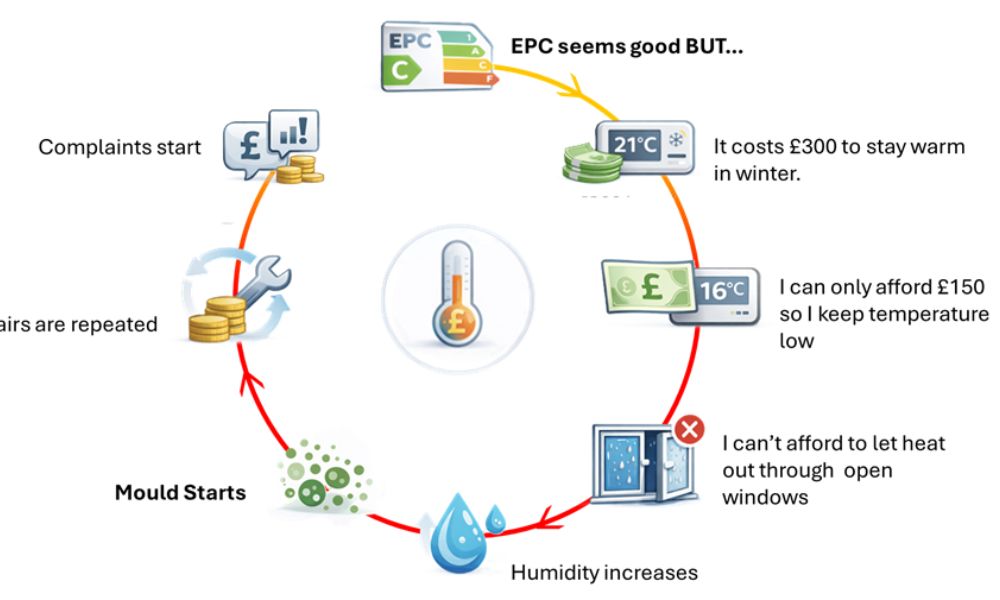
In one case, we calculated that maintaining 21°C during winter would cost approximately £325 per month. The resident confirmed this matched their actual energy bills.
They kept the thermostat at 16°C instead.
The property was damp. Humidity was high. Mould was forming.
We asked them to increase the heating to 21°C for two days to stabilise internal surfaces and reduce humidity. Damp conditions reduced noticeably.
But after two days, they turned it back down.
They simply could not afford to sustain comfort.
This is what fuel poverty looks like in practice.
The Hidden Damp Cycle
When heating is expensive, residents avoid ventilation because opening windows feels like losing money.
Reduced ventilation increases humidity. Higher humidity increases mould risk. Mould drives complaints, inspections and maintenance costs.
If a landlord had known residents would struggle to afford comfort, would they have invested differently — and avoided thousands in repeat maintenance visits?
If landlords included a simple heating affordability check at letting stage, would they avoid ongoing complaints, damp and mould repairs, council inspections, legal disputes and broken contracts?
This is not theoretical.
This is happening today — in a flat and a house near you.
From Ratings to Real-World Physics
At Dampsmart, we ask a different question:
What does physics say it takes to hold this home at 20–21°C when it is cold outside?
- We calculate the Heat Loss Coefficient.
- We model the energy required at defined temperature differences.
- We translate that into weekly and monthly cost.
- Then we validate those results against smart meter data.
We have applied our algorithms across datasets covering millions of UK homes, enabling housing providers to identify where heating affordability is likely to fail before problems escalate.
This allows landlords, councils and housing charities to:
- Target financial support to the most vulnerable
- Prioritise fabric improvements where they matter most
- Prevent unnecessary maintenance cycles caused by under-heated homes
- Avoid misdirected capital spend
It turns data into practical intervention.
Let’s Stop Guessing — and Start Measuring What Matters
EPC ratings have their place.
But compliance does not guarantee comfort.
And a band does not guarantee affordability.
Across the UK, tenants are budgeting blind. Landlords are investing under pressure. Councils are responding to damp and mould after the damage is done.
We can do better.
At Dampsmart, we measure what actually determines winter affordability: heat loss, ventilation behaviour and the real cost of staying warm. We translate physics into practical decisions — before complaints escalate, before money is wasted and before residents fall into debt.
Warmth is not theoretical.
Affordability should not be a surprise.
And performance should be measured in comfort, not just in ratings.
If you want to understand what it truly costs to keep homes warm, and make decisions that protect both residents and budgets, let’s talk.